Offer Redemption Methods Compared: Rotating Codes, QR Tent Cards, Coupons and Tracked Links
How a customer redeems an offer shapes whether merchants honour it and whether customers bother. We compare the main methods for in-store and online offers.
The moment of redemption is where an offers programme succeeds or fails. If it is quick and clear, customers use offers and merchants honour them. If it is slow or awkward, customers hesitate, cashiers improvise and the programme quietly loses trust.
There is no single perfect method. Different merchants, channels and volumes suit different approaches. Here is a practical comparison of the main options.
In-store methods
1. Rotating customer code
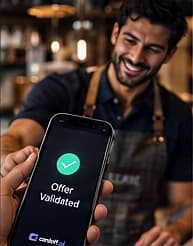
The customer opens the bank's offers app and shows a short code, which changes regularly. The merchant enters it in a merchant validation app on a phone or tablet. The app confirms the offer is valid and records the redemption.
Pros
- Very secure: codes expire quickly, so screenshots and sharing do not work.
- No card number involved.
- Works at any merchant with a smartphone or tablet.
- Merchant sees clear confirmation before giving the benefit.
Cons
- Requires a staff action at the counter.
- Staff need brief training.
Best for: restaurants, cafés, salons, studios and most independent merchants.
2. QR or PIN tent card
The merchant places a printed card with a unique QR code (and often a PIN) at the counter or on tables. The customer scans it with the bank's app, or enters the PIN, and confirms the offer. The staff member sees the confirmation on the customer's screen.
Pros
- Very fast for busy counters; staff do not need to type anything.
- Works even when the merchant does not have a device handy.
- Easy to set up with a printed card.
Cons
- Staff must still check the confirmation on the customer's screen.
- Tent cards need to be kept visible and replaced if damaged.
Best for: high-volume cafés, food courts, cinemas and table service restaurants.
3. POS or terminal integration
The offer is applied automatically through the merchant's point-of-sale system or payment terminal, based on the card used.
Pros
- No extra step for staff or customer.
- Seamless for large chains with integrated systems.
Cons
- Complex and slow to set up; requires technical integration with each merchant or acquirer.
- Often relies on processing full card data, which can bring significant PCI DSS considerations.
- Rarely practical for small and independent merchants.
Best for: large national chains with dedicated IT teams, as a later-phase option.
4. Show-the-card or printed voucher
The traditional method: the customer shows their card or a printed voucher, and the cashier applies a discount manually.
Pros
- Familiar and requires no technology.
Cons
- Hard to verify eligibility; easy to misuse.
- No reliable data on redemptions.
- Inconsistent experience depending on the staff member.
Best for: very little in a modern programme. It is worth phasing out.
Online methods
5. Coupon codes
The customer copies a code from the offers app and enters it at checkout on the merchant's website or app.
Pros
- Works with almost every e-commerce platform.
- Easy for merchants to set up.
- Unique or limited-use codes can reduce leakage.
Cons
- Generic codes can be shared on coupon websites.
- Customers may forget to apply them.
Best for: online stores of all sizes, especially with unique or per-customer codes.
6. Tracked links
The customer taps the offer in the app and is taken to the merchant's site through a tracked link, which may apply the discount automatically or attribute the sale to the programme.
Pros
- Very smooth customer experience.
- Better attribution for reporting.
- Can be combined with an automatically applied code.
Cons
- Requires setup with the merchant's site or affiliate tools.
- Attribution depends on the customer completing the purchase in the same session or within a tracking window.
Best for: e-commerce merchants that want clear attribution and a frictionless checkout.
Side-by-side summary
| Method | Speed | Security | Setup effort | Data quality |
|---|---|---|---|---|
| Rotating code | Fast | High | Low | High |
| QR or PIN tent card | Very fast | High | Low | High |
| POS integration | Very fast | High, but more scope | High | High |
| Show the card | Fast | Low | None | Low |
| Coupon code | Fast | Medium | Low | Medium |
| Tracked link | Very fast | Medium to high | Medium | High |
Choosing the right mix
Most programmes use several methods at once:
- Independent in-store merchants: rotating codes and QR tent cards.
- Busy counters: QR tent cards as the default, rotating codes as a backup.
- Online merchants: unique coupon codes or tracked links.
- Large chains: start with codes or QR, and consider integration later if volume justifies it.
The key is to let each merchant choose what suits their operation, while giving customers a consistent experience in the app.
Tips for smooth redemption
- Keep confirmation screens large and clear, with the merchant's name and the offer in both languages.
- Show the customer exactly what to do before they reach the counter.
- Give merchants a support channel for questions in the moment.
- Monitor failed or disputed redemptions and follow up quickly.
cardoff.ai supports rotating customer codes, QR and PIN tent cards, coupon codes and tracked links out of the box, all without handling card numbers. If you want redemption that works for every kind of merchant, we would be happy to walk you through each option.